
How Zach Lost 21 lbs and 14% Body Fat
Zach came to us like most of our clients do: an adult with a desk job who had been generally meaning to get in shape for a few years and hadn't found a version of it that stuck. No athletic background to fall back on. No interest in becoming a gym person. Just a growing sense that the trajectory was going the wrong way.
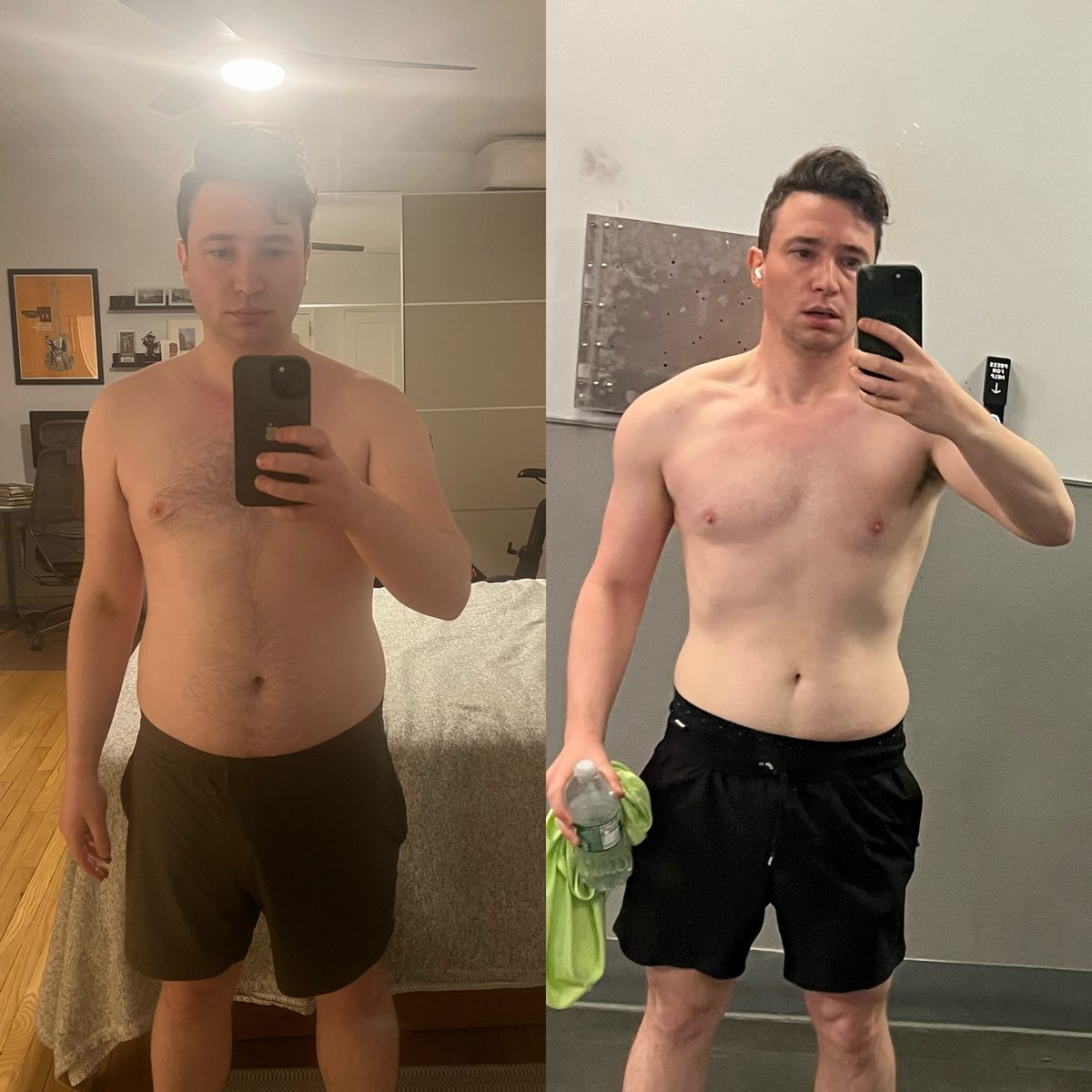
A little over a year later, he's down 21 pounds and 14 percentage points of body fat.
The number that actually matters
The 21 pounds is the headline, but it's the least interesting part of this.
Losing 21 pounds of scale weight while dropping 14 percentage points of body fat means Zach didn't lose 21 pounds of fat. He lost roughly thirty pounds of fat and added close to ten pounds of lean mass at the same time. The scale moved 21 pounds. His body composition moved a lot further than that.
This is the thing most people get wrong when they start. They fixate on the scale, choose the fastest way to make it go down, and end up smaller versions of the same body — lighter, weaker, and with a metabolism that's harder to work with than when they started. Then the weight comes back, and it comes back as fat.
Zach's approach did the opposite. The scale moved slower than a crash diet would have moved it. What he ended up with is a body that's structurally different.
Where he started
Zach's baseline was normal for a New Yorker in his position. He was sedentary through the workweek, walked a fair amount because this is Manhattan, and had no meaningful strength training history. He'd done stretches at commercial gyms — a few weeks here, a month there — but never with a program, never with progression, and never long enough to see anything.
He wasn't looking for a body transformation when he first reached out. He wanted to feel less creaky and stop dreading photos. The rest came later.
What he actually did
Three sessions a week. Every week. For over a year.
That's not a simplification — that's genuinely most of the answer. Zach has trained with us three times a week in our 1-on-2 program, which is semi-private training: one coach, two clients, individual programs run side by side. He's followed the nutrition plan we built for him. And he has been remarkably boring about both.
There was no supplement stack. No fasting protocol. No six-day split. No 30-day challenge. No point at which he trained twice a day or ate 1,200 calories or cut out an entire food group. He showed up three times a week and ate roughly the way we asked him to, and he kept doing that after the initial motivation wore off — which, for everyone, is somewhere around week six.
Why 1-on-2 worked for him
We put a lot of clients in 1-on-2 and it's the format we recommend most often for people in Zach's situation. Three reasons it fit:
Cost. At 3x per week, 1-on-2 is $60 per person per session versus $90 for 1-on-1 at the same frequency. That difference is what made three sessions a week financially realistic instead of aspirational. Two sessions a week works. Three works better, and the only reason most people don't do three is money.
Accountability that isn't about us. Skipping on your trainer is easy — you're paying us, it's your call. Skipping when somebody else is standing in the studio waiting for you is a different psychological equation. Zach has been paired with the same training partner for most of this, and neither of them has been the one to bail.
It's still individualized. This is the part people misunderstand about semi-private. Zach isn't doing his partner's workout. He has his own program, his own loads, his own progressions. The coach is running two programs in parallel, not one class of two. If you don't have a partner, we'll match you with one.
We wrote more about training frequency and why 2-3 days a week beats the standard "train five days a week" advice in How Often Should You Strength Train?
The nutrition side
The training built the muscle. The nutrition is what let the fat come off while he was building it.
Zach's plan wasn't complicated, and we'd say the same thing to anyone: enough protein to support the training, an appropriate calorie target for fat loss, and enough structure that he didn't have to make a fresh decision every time he got hungry. He eats out. He drinks sometimes. He did not white-knuckle this for fourteen months.
What he did do is stay in a mild deficit for a long time instead of an aggressive one for a short time. That's the entire trick, and it's why the lean mass went up instead of down. A slower deficit alongside progressive strength work is the only reliable way to lose fat and gain muscle simultaneously as a non-beginner. Our full take on this is in Nutrition for NYC Strength Trainees.
What the year actually looked like
Progress didn't arrive on a schedule, and it's worth being honest about the shape of it:
- Months 1–2: Strength went up fast. Almost nothing visible. This is the phase where most people quit.
- Months 3–5: The scale started moving. Clothes fit differently before the mirror showed much.
- Months 6–9: The visible change most people are actually chasing. Also the stretch where consistency gets hardest, because the novelty is gone and the finish line isn't in sight.
- Months 10–14: Composition kept improving even when the scale flattened out. Some of Zach's best months on paper were months where he lost almost no weight.
That last point is worth sitting with. There were multiple stretches where the scale did nothing and the body fat percentage kept dropping. If Zach had been judging the program by weekly weigh-ins, he'd have quit during a period when it was working.
What to take from this
Zach is not a genetic outlier and he didn't do anything you couldn't do. What he did was pick a sustainable frequency, get individualized programming, remove the decision-making from his nutrition, and then not stop for fourteen months.
The uncomfortable version of this story is that there's no shortcut in it. The encouraging version is that there's nothing in it you can't replicate — no expensive supplement, no extreme protocol, no willpower most people don't have. Three days a week, a program that progresses, food that supports it, and enough time.
If that sounds like something you'd want help setting up, we're at 347 W 36th Street in Hell's Kitchen, a few minutes from Penn Station, Hudson Yards, and the Times Square subway hub. You can see the full breakdown of what training costs on our rates page, and if you want to talk through whether 1-on-1 or 1-on-2 makes more sense for you, get in touch.
Photo and details shared with Zach's permission.